


Hot Forging is a manufacturing process that shapes metals through hammering, pressing or rolling. Its origins can be traced back to Mesopotamia as early as 4000 BC. The process naturally evolved from simple hammering, as early humans discovered that heating metal made it easier to shape. Blacksmiths used furnaces to heat metals, enabling them to craft weapons and tools such as swords and agricultural implements.
Over the centuries, Hot Forging has undergone significant advancements to meet the demands of modern industries. Let’s get into it.
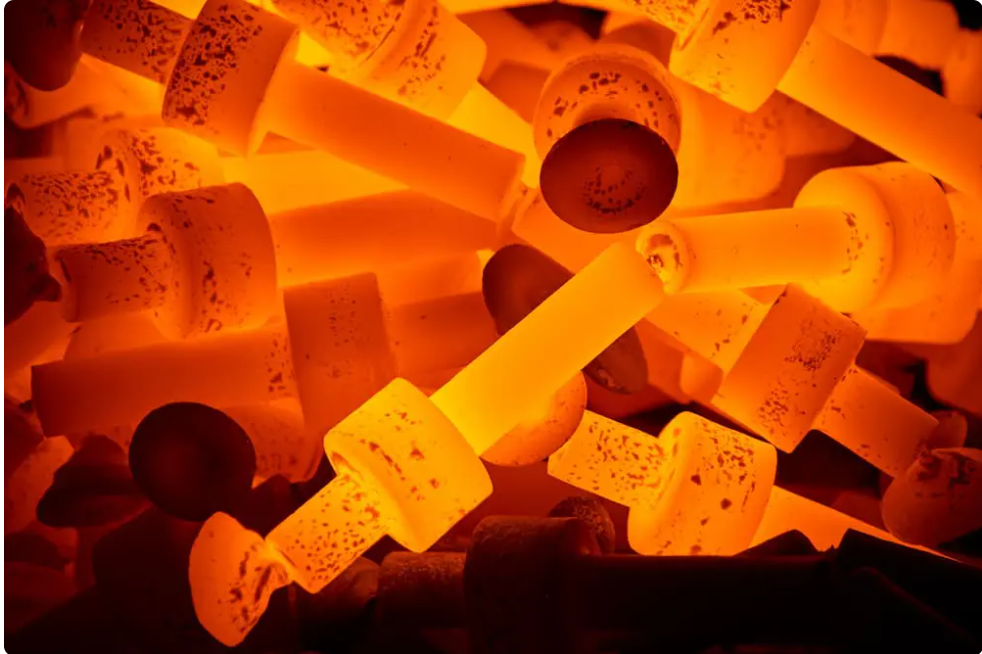
Hot Forging is a manufacturing process that uses heat and high pressure to shape metal into the desired form. When heated to elevated temperatures, raw metal becomes malleable. Manufacturers may employ manual force, hydraulic presses and other specialised equipment to shape the metal with relative ease.
Some of the popular metals used in Hot Forging include alloy steel, aluminium, brass, carbon steel, copper, duplex steel, nickel, stainless steel, titanium, and tool steel. Generally, metals that are not highly brittle can undergo Hot Forging processes. On the other hand, materials like cast iron, certain high-carbon steels, and other brittle alloys are unsuitable for Hot Forging due to their inability to withstand impact loads.
Forged parts provide numerous advantages, including a refined grain structure, higher fatigue resistance and strength. Additionally, the final product is free from defects such as porosity, cracks and blowholes.
Hot Forging can be engineered to mass-produce parts without using excess metal. It is widely used in safety and performance-oriented industries, including aerospace, automotive, and oil and gas, for critical components such as crankshafts, high-pressure valves, ball joints, cams and gears.
Heat and high pressure soften most metals, allowing Hot Forging to be effective with a wide range of materials. However, because the properties of different metals vary, the Hot Forging process must be adapted accordingly. Let’s explore a typical Hot Forging process to understand its main steps:
Modern Hot Forging processes use dies to enhance the accuracy, precision and speed of parts produced. Die design and manufacturing is the first step in the Hot Forging process. A good die can provide advantages such as better grain flow, good surface finish, less wastage, improved dimensional accuracy and consistent production quality.
Billets or ingots with varying cross-sections serve as raw materials for the Hot Forging process. Depending on the product specifications, the required lengths of the appropriate cross-sections are cut and incorporated into the Hot Forging production line.
There’s no point beating on a metal that is cold. In this step, the metal is heated, typically in a furnace, to its Hot Forging temperature. The Hot Forging temperature for steel ranges from 850 to 1150 degrees Celsius, while the ideal Hot Forging temperature for aluminum is up to 500 degrees Celsius. The specific heating and soaking temperatures for the Hot Forging process are determined based on the type of metal being used.
The heated metal is moved to the die, where it is pressed into shape. Multiple passes through various dies may be necessary to achieve the final form. Additionally, the part may require reheating between presses.
Most components are subjected to heat treatment following Hot Forging to enhance specific mechanical properties, including strength and hardness. The heat treatment processes that are normally used are annealing, tempering, quenching, normalising, solution treatment and case hardening.
Cooling presents an excellent opportunity to enhance properties such as strength and grain structure. By employing various cooling mechanisms and rates, the development of desirable characteristics in forged components can be promoted.
The component may require finishing operations, such as machining, trimming and surface treatment, before it is fit for use. Additionally, properties like corrosion resistance and aesthetic appeal can be enhanced by applying specific coatings during this stage.